
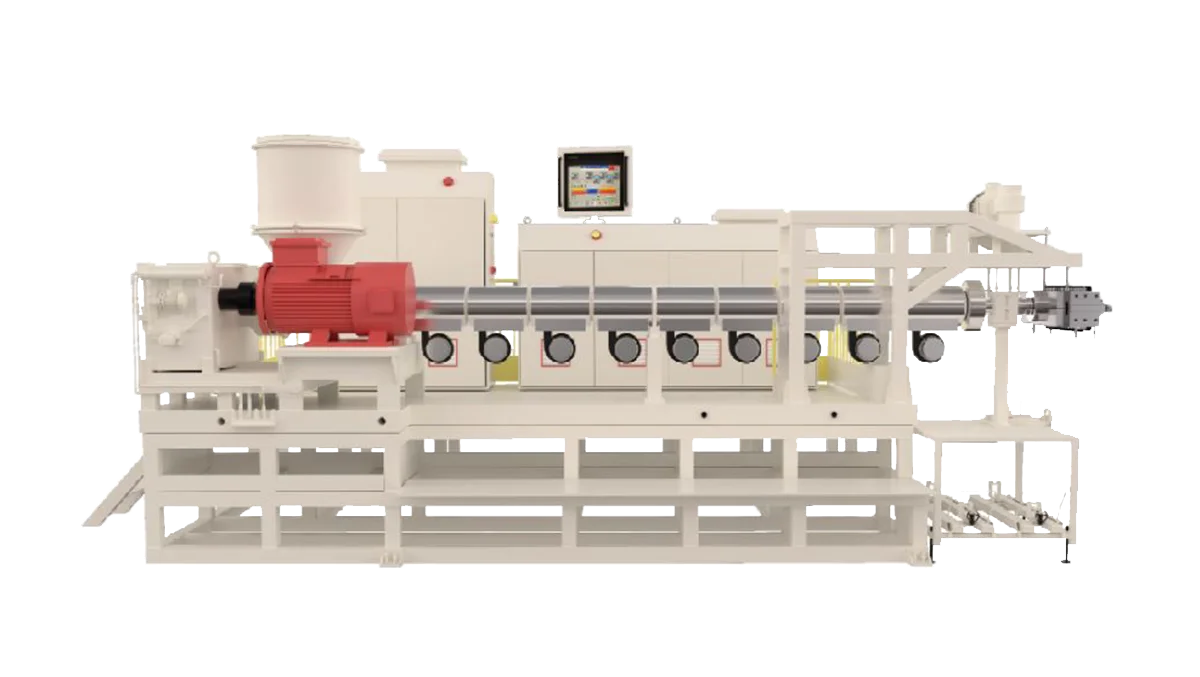
In flooring extrusion production, T-die lip clearance directly dictates cross-web melt distribution before calibration. For manufacturers producing PVC-free flooring, small variations at the die outlet can influence thickness accuracy, surface appearance, and production stability. This is especially important for flooring materials containing mineral fillers or composite components, where melt flow behavior can be different from traditional PVC materials.
A pvc free flooring extrusion line requires precise control of extrusion pressure, temperature, and forming conditions. Proper die lip adjustment helps maintain consistent material flow, minimize cross-machine direction (CD) gauge deviation, and improve the reliability of continuous production.
Why Die Lip Adjustment Matters in PVC-Free Flooring Production
The die lip is the final section where the melted material leaves the extrusion system and begins to take its finished shape. The gap between the die lips determines how much material passes through different areas of the die opening. If the gap is uneven, the material distribution across the flooring width may become inconsistent.
In actual factory production, uneven die lip settings can create several problems. For example, one side of the flooring board may become thicker than the other side, requiring additional calibration adjustments. In severe cases, the final product may fail to meet thickness requirements and become waste.
For PVC-free flooring, the challenge can be greater because many formulations include mineral fillers. These fillers can change the flow resistance of the material, meaning the same die settings may not always provide the same results when manufacturers change formulas or product designs.
Proper die lip optimization allows operators to match the die opening with the material characteristics and production conditions, helping maintain more stable extrusion output.
Common Die Lip Issues During Flooring Extrusion
During long production runs, manufacturers may experience several problems related to die lip performance.
One common issue is uneven thickness distribution. When the die lip gap is not adjusted correctly, the material may not spread evenly before entering the calibration stage. Operators may need to frequently adjust downstream equipment, which increases setup time and can reduce production efficiency.
Surface defects are another concern. Material buildup near the die lip can create irregular flow paths, resulting in visible marks or uneven surfaces on the flooring. For decorative products with wood grain or stone patterns, even small surface problems may affect the final appearance.
Pressure fluctuation is also a practical problem in extrusion factories. Changes in raw material batches, temperature conditions, or production speed can influence melt pressure at the die. If the die lip adjustment does not match these changes, operators may see unstable output or require repeated manual corrections.
Regular cleaning and inspection of the die system are therefore necessary. Removing material residue and checking the condition of the die lip can help maintain consistent forming performance.
Improving Material Flow Control Through Die Lip Optimization
Optimizing the die lip is not only about adjusting the opening size. It requires coordination between material preparation, extrusion parameters, and downstream forming equipment.
Temperature control is an important part of the process. If the material temperature before entering the die is unstable, the viscosity of the melt may change and affect flow distribution. Maintaining consistent heating conditions helps operators achieve more predictable die performance.
Extrusion speed and pressure should also be considered during adjustment. When production speed increases, the material has less time to flow through the die, which may require changes to the die setting. For factories producing different flooring specifications, operators often need to record suitable parameters for each product type.
Using a reliable non pvc flooring extrusion line allows manufacturers to better coordinate extrusion, forming, and control systems. Stable equipment operation makes it easier to maintain consistent die pressure and reduce fluctuations during continuous production.
Equipment Features That Support Better Die Lip Performance
The performance of the die lip is closely related to the overall extrusion equipment design. A suitable system should provide accurate temperature management, stable material feeding, and convenient parameter adjustment.
Modern extrusion equipment with PLC control allows operators to monitor production conditions and make adjustments more efficiently. By tracking temperature, pressure, and extrusion speed, production teams can identify changes earlier and reduce the risk of producing defective flooring.
Mechanical precision is also important. The die structure, processing accuracy, and adjustment mechanism all influence how consistently the die lip performs over time. Equipment designed for continuous industrial production should consider not only initial output but also long-term stability.
Boyu has more than 20 years of experience in extrusion equipment manufacturing and focuses on customized solutions for flooring and plastic extrusion applications. With professional technical teams and engineering experience, the company provides equipment solutions designed around different materials, production targets, and factory requirements.
Reducing Production Waste with Better Die Lip Management
Effective die lip management helps flooring manufacturers reduce material waste, improve surface consistency, and shorten adjustment time during production. Instead of correcting problems after defects appear, manufacturers can improve stability by controlling material flow from the forming stage.
When selecting extrusion equipment, businesses should evaluate die design, automation capability, maintenance requirements, and technical support. These factors influence not only production speed but also the consistency of finished flooring products.
A properly configured pvc free flooring extrusion line can help factories achieve better process control, reduce adjustment frequency, and maintain stable flooring production quality.With extrusion technology experience and customized equipment solutions, Boyu supports manufacturers in improving production reliability.