
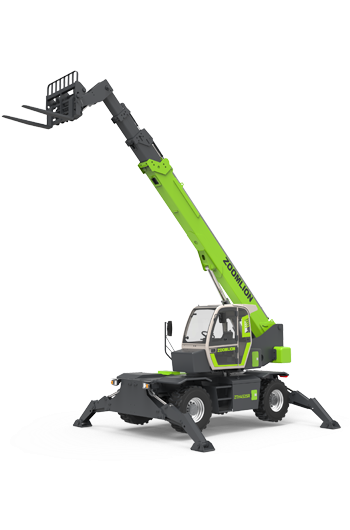
Industrial installation projects often require heavy components to be lifted into position above machinery, pipework, structural frames, or existing production lines. When access routes are narrow and ground space is restricted, conventional material-handling equipment may struggle to reach the required position without repeated repositioning. A rotating telehandler can help address these challenges by combining telescopic reach with a rotating upper structure, allowing operators to serve multiple working positions from a planned setup.
For industrial contractors, equipment selection involves more than maximum lifting height. Load capacity at the required reach, ground conditions, available setup space, attachment compatibility, and safe operating procedures all influence productivity. Zoomlion Access’s ZTH4525R provides a practical example of how rotating telehandler technology can support demanding installation work when site conditions and machine limitations are assessed carefully.
Why Rotating Telehandlers Suit Space-Constrained Installations
Industrial facilities frequently contain permanent obstacles, including storage racks, conveyor systems, steel columns, and production equipment. Moving a machine repeatedly around these obstacles can consume valuable time and introduce additional traffic risks. A rotating telehandler can reduce some repositioning requirements by rotating its upper structure through 360 degrees while the chassis remains in its selected position.
This capability is useful when lifting components onto elevated platforms, positioning structural materials, or delivering equipment to different points around an installation area. However, rotation does not eliminate the need for adequate clearance. Contractors must account for the machine’s footprint, boom movement, counterweight swing, attachment dimensions, and the movement of personnel nearby.
A detailed site survey should therefore precede equipment selection. Measurements of access openings, overhead obstructions, floor loading limits, and the proposed operating area help determine whether a particular machine can work safely without disrupting adjacent operations.
Match Working Height and Load Capacity to the Task
Maximum lifting height is an important starting point, but it does not establish how much weight a machine can handle at every boom position. As the boom extends and the load moves farther from the machine, available lifting capacity can decrease significantly. Contractors should consult the manufacturer’s load charts for the exact configuration, including the attachment, load position, and stabilizer arrangement.
The Zoomlion Access ZTH4525R has a maximum lifting height of 24.8 m, a rated capacity of 4,500 kg, and a maximum forward reach of 19 m. Its published specifications also list a lifting capacity of 2,000 kg at maximum height and 300 kg at maximum forward reach. These figures illustrate why capacity must be checked at the actual operating position rather than inferred from the headline rating.
For industrial installation teams, this distinction is especially important when handling steel assemblies, HVAC components, pipe sections, or packaged machinery. The planned lift should account for the component’s verified weight, rigging equipment, attachment weight where applicable, and the required placement accuracy. If the load chart does not support the intended operation, the team should select another machine or revise the lifting plan.
Assess Ground Conditions and Setup Requirements
Limited space often comes with additional site constraints. Industrial floors may have restricted load-bearing capacity, while outdoor installation areas may include compacted soil, gradients, drainage channels, or recently excavated ground. A machine’s ability to travel over rough terrain does not automatically mean every surface is suitable for lifting.
The ZTH4525R features a 4×4 driving system designed to provide traction and off-road capability. Its published specifications list an overall width of 2.48 m and an outside turning radius of 4.2 m. These dimensions help planners evaluate access routes and maneuvering areas, but they do not replace a site-specific assessment of floor strength, clearances, and support conditions.
Before work begins, contractors should identify underground utilities, verify ground-bearing capacity, and establish any required exclusion zones. Where stabilizers are used, the supporting surface and deployment space must be suitable for the planned operation. The machine’s operating manual and applicable load charts should guide setup decisions, especially when the boom will be extended at height.
Select Attachments and Control Systems Carefully
Industrial installation work varies considerably from one project to another. Forks may suit palletized materials, while compatible platforms, buckets, or other attachments can support different tasks when specifically approved for the machine. Dealers and contractors should verify attachment compatibility, load limits, and the operating procedures required for each configuration before mobilization.
The ZTH4525R comes with standard floating forks and offers optional platform, bucket, and boom attachments. Zoomlion Access also highlights hydrostatic drive, three steering modes, and a 10.1-inch display integrating monitoring and control functions. These features can help operators adapt the machine to changing site requirements, provided each selected configuration is permitted by the manufacturer’s instructions.
When comparing options from telehandler manufacturers, buyers should examine more than the number of available attachments. The important questions are whether the attachment is approved for the specific model, how it changes the machine’s permitted capacity, and whether the operator has the necessary training. A rotating telehandler should never be treated as a universal lifting solution simply because it supports multiple configurations.
Make Safety Planning Part of Equipment Selection
Restricted installation areas can bring workers, other vehicles, fragile equipment, and overhead structures into close proximity. A site-specific lifting plan should define the load path, operating boundaries, communication methods, and procedures for controlling access. Personnel on foot should be separated from equipment movements wherever practicable.
Operators need to understand load charts, ground limitations, attachment requirements, and the machine’s operating controls. Additional precautions may be necessary when handling suspended loads, working near energized equipment, or lifting around existing structures. Training and supervision should reflect the actual task, not just general familiarity with telescopic equipment.
For buyers evaluating telehandler manufacturers, documentation and technical support are important considerations alongside performance specifications. Zoomlion Access lists the ZTH4525R as CE certified. Contractors should verify the relevant conformity documentation for their market, review the operating manual, and confirm that the planned application complies with local requirements. Certification alone does not guarantee that a particular lift is safe.
Improve Project Efficiency Through Better Planning
The benefits of rotating equipment depend on how well the lift sequence is organized. Before mobilization, project managers should map delivery routes, identify component staging areas, coordinate installation schedules, and determine where the machine can remain positioned while serving multiple work locations. This preparation can reduce unnecessary movement and limit interference with other trades.
Equipment availability, transport arrangements, maintenance support, and operator competence also affect project economics. Buyers should compare the full operating requirements of shortlisted machines rather than choosing solely on maximum height or purchase price. Consulting technical documentation and discussing the application with suppliers can help identify constraints before equipment arrives on site.
Choose Equipment Around Real Site Conditions
Industrial installations with limited space demand a careful balance between reach, capacity, maneuverability, and safe setup. A rotating telehandler can offer valuable flexibility, but its suitability depends on the actual load, working radius, ground conditions, clearances, and approved attachment configuration.
The Zoomlion Access ZTH4525R combines a 24.8 m maximum lifting height, 4,500 kg rated capacity, continuous 360-degree rotation, and four-wheel drive. These specifications make it worth evaluating for appropriate industrial installation projects. Contractors who verify load charts, plan the work area, and establish clear safety procedures can make better-informed equipment decisions and reduce avoidable delays on complex sites.