
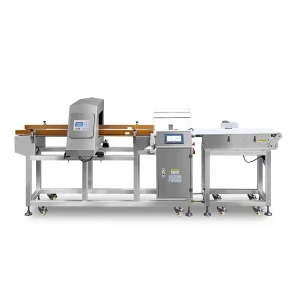
Food contamination control depends on choosing the right inspection method. The method should match the material, packaging, and production conditions. Food Industry Metal Detectors work well for ferrous, non-ferrous, and stainless-steel fragments. X-Ray inspection can find a wider range of dense foreign materials. Easyweigh provides a useful reference. It shows inspection equipment’s place in modern food quality management. No single method is universally suitable.
Detection Principles And Material Response
Metal detection relies on electromagnetic interaction rather than an image of the inspected product. A transmitter creates a controlled field through the aperture, and conductive particles passing through it disturb that field. Signal characteristics vary according to the type, size, shape, and orientation of the contaminant.
X-Ray inspection takes a different route by measuring differences in X-Ray absorption. Dense materials such as glass, stone, mineral fragments, and metal can produce detectable contrasts against many food products. The resulting image gives processors another way to examine contamination risks that may not respond strongly to electromagnetic detection.
Product characteristics also affect the practical sensitivity of each approach. Moisture, salt, temperature, and conductivity can influence metal detection performance, particularly with products that create a strong product signal. X-Ray inspection may be less affected by those specific properties, although density, package geometry, and product composition still matter.
Where Metal Detection Fits Best
Many packaged foods pass through conveyors or vertical lines where metal fragments represent a realistic production hazard. Food Industry Metal Detectors can inspect products continuously without requiring direct visual access to individual pieces. Their compact inspection apertures also make them suitable for integration into established processing layouts.
Packaging materials play an important role in equipment selection. Flexible films, cartons, and many plastic containers can pass through metal inspection without creating the same density-related considerations associated with X-Ray imaging. This can make metal detection a straightforward option for applications where the principal concern is metallic contamination.
Operational factors deserve equal attention. Inspection sensitivity should correspond with the product being examined, while reject devices need to match package weight, conveyor speed, and line configuration. Regular performance checks help operators recognize changes that could affect inspection results during routine production.
Understanding The Strengths Of X-Ray Inspection
X-Ray inspection becomes particularly useful when contamination risks extend beyond metal. Glass shards, stones, calcified bone, and certain high-density plastics may create sufficient contrast to be detected. Such capability can be valuable in food categories where raw-material variability introduces several types of physical hazards.
Packaging does not necessarily prevent inspection. Products sealed in cans, trays, pouches, or other containers can be examined after packaging because the method evaluates density differences rather than electrical conductivity. This characteristic expands its usefulness across applications where packaged-product inspection is required.
Another distinction involves additional quality checks. Depending on the equipment configuration, X-Ray inspection can support checks related to missing components, fill levels, broken products, or package irregularities. Those functions can provide operational value beyond foreign-body detection, although suitability depends on the individual product and inspection objective.
Aligning Equipment Supply with Production Realities
No two food plants operate under identical conditions. Package dimensions, conveyor layouts, and contamination risks vary from site to site. A standard inspection unit may not fit every line. Easyweigh works with B2B customers through OEM and ODM cooperation. Aperture size, belt width, and reject mechanism can be adjusted during development. Software parameters, interface language, and data output can also be tailored.
Before delivery, sample testing with actual products confirms detection performance. After installation, training, spare parts, and technical support remain available. When product formats or line speeds change, the equipment can be updated through modular hardware changes or software revisions. This approach keeps inspection aligned with long-term production needs without forcing the line to adapt to a fixed configuration.
Building A Practical Inspection Strategy
Food manufacturers often benefit from viewing inspection as one part of a broader hazard-control process. Raw-material screening, supplier controls, equipment maintenance, sanitation practices, and production checks each address different sources of risk. Inspection equipment functions most effectively when its role is clearly defined within that wider framework.
Verification procedures are equally important. Test pieces or reference standards should reflect the intended inspection conditions, including product type, packaging, orientation, and line speed. Records from routine checks can help identify gradual changes in performance and provide useful evidence during internal quality reviews.
Equipment selection can also be influenced by future production plans. Changes in recipes, package sizes, throughput, or product temperature may alter inspection conditions. A processor evaluating Food Industry Metal Detectors should therefore consider not only today’s products but also whether the selected configuration can accommodate foreseeable operational changes.
Making The Inspection Choice With Confidence
The comparison between metal detection and X-Ray inspection is less about declaring one method superior and more about matching detection principles to actual contamination risks. Metallic fragments, product conductivity, packaging, density differences, throughput, and quality-control objectives all shape the most practical choice.
Easyweigh can be considered within this broader equipment landscape, while the final evaluation should remain grounded in product-specific trials, production conditions, and documented hazard-control requirements. A carefully matched inspection approach gives food processors a clearer path toward consistent physical-contamination control without adding unnecessary complexity.